Day 15: Saturday, November 5 Bisbee, AZ to Douglas, AZ Miles: 25 (696.5) Flats: 0, 8 (trip, total) Elevation: 5600 ft to 4000 ft
We woke to the dreaded sound of rain. We are biking through like 3 deserts, for crying out loud! We are not prepared for rain! Fortunately, the rain was gone shortly before we wanted to hit the road, but the cold and wind remained.
I had prepared for the cold. I hate being cold and I bought a new down jacket and new merino wool long johns just for this trip because I hate being cold. And I dragged those long johns and down jacket all through the heat of the Sonoran desert and when I got to Tucson, I did something silly. It was unseasonably warm when we arrived, so I left my warm clothes with a friend who would bring them to El Paso where I could pick them up in a couple weeks. So, I awoke in Bisbee to 45 degree temperatures, kicking myself.
Up to this point, our rides have been warm, if not hot. We have planned to get on the road with the first light so we miss the heat of the day. So, every riding day up until this one, I have worn my Chaco sandals (and I have quite an impressive tan line to prove it). Today was my first day using my tennis shoes, and I had to wear wool socks too! And not only did I wear wool socks on my feet, but also on my hands! Luckily, Peter, who we stayed with in Bisbee, donated scarves to us, which kept us from freezing.
My tan lines three weeks before in Puerto Penasco
(I swear, we put on sunscreen 2x per day)
The new cycling outfit featuring sock hands
It was a short ride and it was all downhill and we just flew. It was really chilly and very windy, but it was quite invigorating. We arrived in Douglas right on time and headed over to the house of the School Sisters of Notre Dame, who had offered us hospitality.
There are 4 sisters in the house, and they are so kind and welcoming. They have been in the area for only a year and work with migrants in Agua Prieta and immigrants in Douglas, participate in water drops in the area, and much more. They welcomed us in their beautiful home and immediately served us a hot meal and we sat conversing for almost 3 hours! I am continually surprised and impressed and ever so grateful and how Eric and I are welcomed on our trip, especially given that we only give people a few days notice of our arrival! How we are blessed.
We were welcomed in Bisbee (population 6,000) by near-famous/probably-famous-in-some-circles painter Peter Young. After arriving and showing us the vacated apartment we could stay in, Peter immediately gave us a walking tour of the adorable historic Bisbee which included its very own OccupyBisbee!
Peter is one of many artists in Bisbee, but he is one of the few people there involved in work with migrants in Naco, Sonora. Bisbee is only 11 miles from the U.S.-Mexico border and a few years ago a devoted group from Bisbee started a migrant outreach shelter for people who were deported to the small town of Naco. The shelter offered food, clothing and an orientation to resources available to migrants, but one thing they did extremely well was document human rights abuses. I posted previously about A Culture of Cruelty and the staff of the center, including Peter and the director Cecile Lumer (who we also had the privilege of meeting in Bisbee though she was recovering from knee replacement surgery), provided a lot of the data used in that report.
Unfortunately, last summer the Department of Homeland Security decided to stop deporting people to Naco, so this migrant center is now empty. Everyone in social services hopes their work will no longer be necessary in the future, but this was not the desired scenario. Instead of deportations slowing or ending, DHS has just stopped deporting to Naco and is instead sending deportees to other cities which may not be as prepared. Peter and Ceclie speculate that DHS stopped deporting people to Naco because they were so prepared and because of the fact that they were able to talk to a high percentage of deportees about human rights abuses. Either way, the center is closed for now, but other projects continue.
Migrant resource center of Naco, Sonora
The day after we arrived, Cecile's friend Carol brought us over to Naco with her. We attended a Plan Naco meeting at the Naco Wellness Center. Plan Naco is a new binational collaboration that includes a sewing course and cooperative, diabetes education including building gardens and greenhouses, a clinic and health education for low income residents, and other projects. It is so new that we helped them proofread their brochure and hoped with them that they are not biting off more than they can chew! It sounds like an awesome effort and it was great to see that it was actually bi-national, with the meeting participants split about 50/50 from Bisbee, AZ and Naco, Sonora.
Plan Naco meeting at the Naco clinic
Tom, Carol, Lupita, Sister Mary Rose at the clinic
After the meeting and some lunch, we stopped briefly to drop off some medical supplies at the house of a young man who is now quadriplegic after being involved in a shooting. After listening to the big dreams at the Plan Naco meeting and after hearing of some politics among the Bisbee volunteers that have caused several groups to go in different directions, it was really great to see a young man who is benefiting from this work. When volunteer Tom met this young man, he was skinny and confined to bed, but is now going to receive his second wheelchair from them after having outgrown his first!
On the way back to the bridge, Tom also showed us part of the diabetes wellness project--building greenhouses from trampoline frames!
Tom shows us his greenhouse project using a trampoline frame
After the halt in deportations in the Bisbee/Naco area, it was great to see how these committed individuals (in this case, mostly retired snow birds) changed the direction of their efforts to better their own well-being and that of their greater, binational community.
Wednesday, November 2 Nogales, AZ to Sierra Vista, AZ Miles: 76.5 (total: 654.5) Flats: 0,8 (trip, total) Elevation: 3800 ft to 4600 ft
After so many days of rest, it was fantastic to get on the road again. And it didn't take long for the route to get really beautiful. We rode past jagged mountains and through vast grassy fields. It was lovely.
The roads were quiet and we were left to enjoy the silence and the beauty around us. Our other companions on the road were the many large and colorful grasshoppers that would jump and float around us while the corpses of their deceased comrades would crunch under our tires.
The scenery was pretty and serene until we arrived in Huachuca City and Sierra Vista which houses most the soldiers of neighboring Fort Huachuca which has an annual protest similar to the School of the Americas protest at Fort Benning, GA. We hoped to find camping in Sierra Vista, but no RV park would take us so we resigned to go 10 more miles down the road to camp at the San Pedro River. We probably should have taken it easier on Eric's ankle our first day back in the road, but instead we set a new record for daily mileage!
The river had just a small amount of water trickling through, but it was lined with big beautiful cottonwood trees. It was a chilly night, but a really nice place to camp for only $2.00 (well, we didn't have dollars so we left 25 pesos)!
Camping on the San Pedro River
Thursday, November 3 Sierra Vista, AZ to Bisbee, AZ Miles: 17 (671.5) Flats: 0,8 Elevation: 4600 ft - 5600 ft
We only had a short day of riding, but it was all uphill. It was up and up and up to get to Bisbee, AZ, often only traveling at about 3 miles per hour.
Right outside Bisbee, there was a long tunnel and a sign that it was a 6% downhill grade for the next several miles. Realizing we were done with the uphill, we entered the cave hooting and hollering and crying from the wind in our face. And down we flew into Bisbee, the cutest little town in Arizona*!
After a 30 mile test ride to see if Eric's ankle had healed, we decided to get back on the road, but first we wanted to visit Nogales, Sonora. We had worked in Nogales, Sonora with No More Deaths in August and it was great to be back and see some familiar faces. We also picked an amazing day to be there--Day of the Dead.
Before heading back to our old stomping grounds or checking out the cemetery, we connected with the sister organization for Borderlinks, HEPAC--Hogar de Esperanza y Paz, A.C./ Home for Hope and Peace.
The building where neighborhood kids get lunch everyday!
HEPAC has been around for 33 years, originally as the project of one person, then as the Mexican counterpart of Borderlinks and now, for the last two years, as its own non-profit. When it was started, the aim was to feed the children in the neighborhood of Bella Vista. Public school in Mexico is only for half the day, so the kids with class in the morning would eat after school, and the kids with class in the afternoon would go to class with a full stomach. Located in a poor colonia of Nogales, this project assured that the neighborhood kids were feed one solid meal per day. This program still exists and like many organzations we have seen, there are different volunteer cooks every day who come to prepare the meals. (There were no kids the day we visited though, since it was a holiday.)
Mary Cruz showed us around HEPAC
The neighborhood of Bella Vista in Nogales, Sonora
The next project HEPAC took on was building a daycare. Many of the families in the colonia are only single mothers and this service allowed them greater ability to work. Then came a women's cooperative, which makes beautiful copper pendants which read No Mas Muertes (not for the organization, just calling for an end to the horrible migrant desert deaths). The money they earn is split between the women, the HEPAC center, and Nogales organizations that work with migrants. They also have a community garden, and Mary Cruz, the woman we spoke with, also co-leads educational groups with Borderlinks of Tucson.
Afer visiting HEPAC, we stopped by the Casa de la Culture of Nogales and saw their display of altars for Day of the Dead.
Altar at the Casa de Cultura
I love Day of the Dead. It is a holiday that I really want to celebrate in my own family. I love the idea of honoring your ancestors and having this special day devoted to making their favorite foods, telling stories about them and cleaning the site in which they were laid at their death. Having this day each year to remember and reminesce is a wonderful tradition.
After visiting the cultural center, we headed to the cemetery which was packed with people and surrounded by food and flower vendors. My favorite were the truckloads of marigolds--so pretty!
I was going to sneak a picture of this beautiful flower stand, but this guy was happy to pose for me!
Yummy sugar skulls!
The Nogales cemetery, bustling with people cleaning and adorning the graves of their loved ones.
Projects in Nogales worth mentioning that offer services to migrants:
-Kino Border Initiative which is run by Jesuit priests and serves two meals per day to migrants and deportees and has a free clinic and offers educational delegations
-Casa San Juan Bosco, a shelter that offers hospitality to migrants and deportees for 3 days
-No More Deaths, which sets up at a bus station and offers free phone calls to migrants and deportees and documents human rights abuses
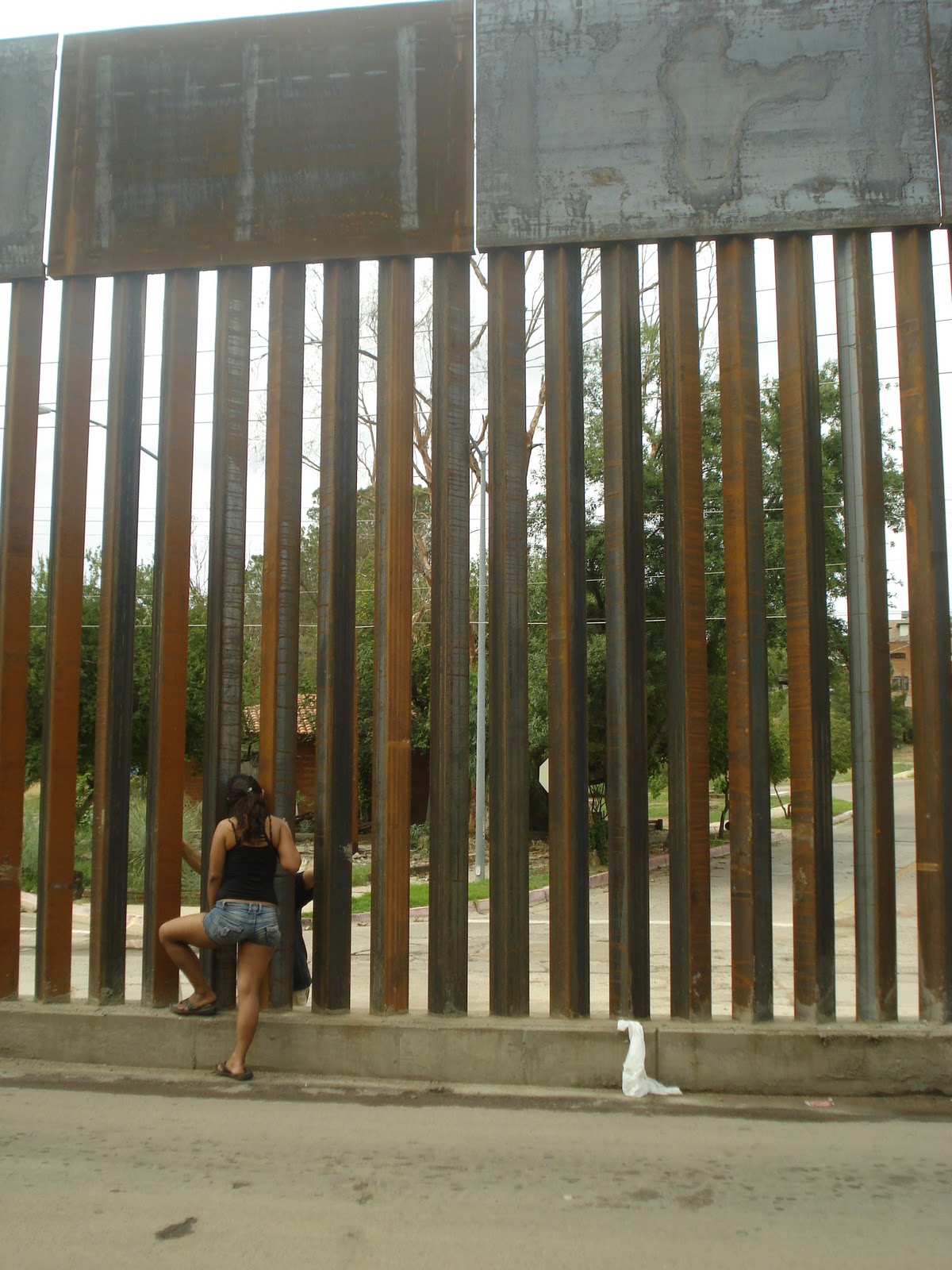
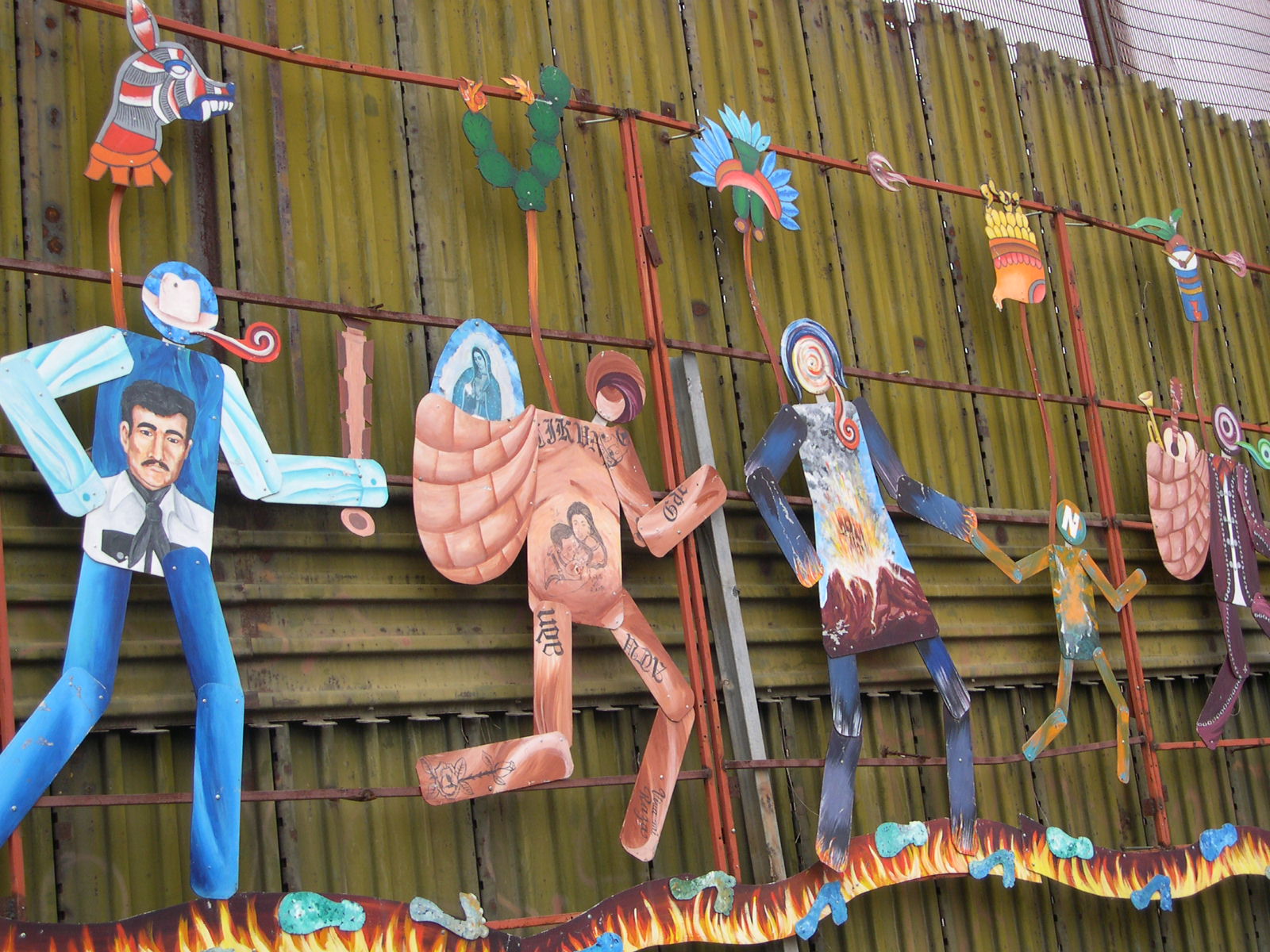
I visited a couple friends in Tucson in fall 2009 and spent one day in Nogales during my stay. At that point, there was some very powerful art on the Mexican side of the border wall, which I was surprised to see was removed when I came back to Nogales this summer. They have put in a new, taller wall in the area and I have heard that the art from the fence is now in a gallery in Tubac, Arizona, but I can't find anything about it online. Though it is no longer there, for your viewing pleasure, I wanted to post the photos I took of the art a few years back.
But first, so you can see what the wall looks like now (though there aren't always couples kissing through it):
And not too long ago:
Borders = Scars on the Earth
These stainless metal pieces are a play on Mexican milagros, small metals that are offered in prayer
Eric and I were super fortunate to stay in an intentional community during our pre-trip 3 weeks tune-up-the-bikes-time in Tucson. It is called Casa Mariposa and their outreach focuses on immigration detainees.
Artwork at Casa Mariposa
With increased militarization of the border and legislation like SB-1070, the number of immigration detainees has skyrocketed in the past few years. Why? Because there are HUGE profits to be made. Who is profiting? Well, the writers of SB-1070, of course!
Model legislation which was almost word for word Arizona's SB-1070 was written by ALEC, the American Legislative Exchange Counsel, a "non-partisan" conservative organization. Members of ALEC include the biggest players in the private prision industry, like Corrections Corporations of America, who as a private prison have a vested interest in housing as many people in their facilities as possible, and congresspeople, who can introduce the model legislation and win campaign financing from the huge corporations who are profitting from it. Watch this super short, awesome video that explains it better than I can: Immigrants for Sale.
Detention Facts:
Every night, an average of 32,000 people are in detention--last fiscal year 407,000 people spent time in immigration detention. see here
Detention facilities are often accused of poor medical care and 122 people died while in immigration detention from 2003-2011. see here (This great Washington Post article reported that most these deaths were occurring to young people: 32 of the 83 deaths in the last 5 years have happened to detainees under age 40. )
While only 8-9% of the U.S. prisons are private, 49% of immigration detention facilites are privately run. (Full disclosure--I have no citation, but learned this from a friend)
The average cost of detaining someone is $122/day. (Imagine that money reinvested in education!) see here
Casa Mariposa/the Restoration Project work in collaboration with The Florence Project, an incredible legal organization in the Middle of Nowhere, Arizona, that serves immigration detainees. They have a project to set up pen pals and visitations to those in detention who need it most and have monthly vigils outside the complex of jails and detention centers that make up Florence, AZ to let those inside know that they are not forgotten.
Monthly vigil at the Pima County Jail in Florence, AZ
Eric and I got the chance to head up to Florence one day in September and visit some detainees there. The man I spoke with was from Iran and had been living in the United States since he was a child. He had residency for many years, but was under threat of getting it stripped due to some minor drinking or drug charge. He was ardently Christian and genuinely feared for his life if he was returned to Iran, where he had not lived for over 20 years. He was arrested in California and that is where all his friends and family reside so no one is able to visit him. For this reason, the social worker at the Florence Project elected him for the pen pal/visitor project. Without previous warning, the man I visited was called for a visit and I am sure he was like, "who the heck are you!?" when he saw me in the booth, but after I associated myself with the Florence Project he opened up and after the 30 minute visit, he kept telling me over and over how nice it was to have someone to talk to. Even though we were only able to visit one person each, it was nice to feel like we may have helped ease the loneliness of those two men for a little while.
I have visited several people in jail and immigration detention and one thing that really struck me was the fact that at this facility I was not even in the same room as the person I was visiting. Just like in the movies, usually a visit involves sitting on one side of a thick piece of glass while speaking through a telephone to the other person on the other side. In this facility, the visitor's chair faced a television screen and a small camera, so the visitor was essentially via skype! The worst thing about this was that you could never make eye contact with the person: you either looked at the camera or the tv screen.
Pime County Jail where we visited immigration detainees in Florence, Arizona
Another aspect of Casa Mariposa that we were involved in is called The Greyhound Project. Earlier this spring, it came to the attention of the community at Casa Mariposa that every weeknight, ICE drops off people released from detention at the Greyhound station (usually folks released on bond). Usually this drop off happens between 8:30-9pm and the station closes at midnight. Often, people are able to get on the two busses that leave after 9pm, but if they cannot get in contact with family to purchase a bus ticket or if there are simply not any seats on these 2 busses left, they are asked to leave the station and the employees refer them to the 24-hour Denny's. When Mariposa realized this was happening, they made a committment to be at the Greyhound station every night and offer hospitality to anyone who doesn't make it on a bus. If guests do come back to the house, another community member usually will get up at 5:00am to make a light breakfast, wake up the guests and walk them back to the station about a mile away.
In my time at Annunciation House, I realized the powerful feeling that comes along with being able to open your house to someone in need. It is so intimate, yet such a basic need. Hospitality is incredible work and we were excited to be able to welcome guests into the big beautiful house that is Casa Mariposa, just as the community there had extended us the invitation to stay before we began our bicycle journey. To show our gratitude to Casa Mariposa and our support for the work with detainees, Eric and I made two beds in our time at the house!
Full bed platform we made for Mariposa!
Twin bed we made for guests at Casa Mariposa!
Guest room at Casa Mariposa, complete with two beds made by Katy and Eric!
The fabulous community of Casa Mariposa: Carol, Kate, John and Rachel